Should your ecommerce site talk to the ERP directly?
Orders, invoices and tracking can run automatically without an ERP. When do you need one, and should the site connect to it directly or through a layer?


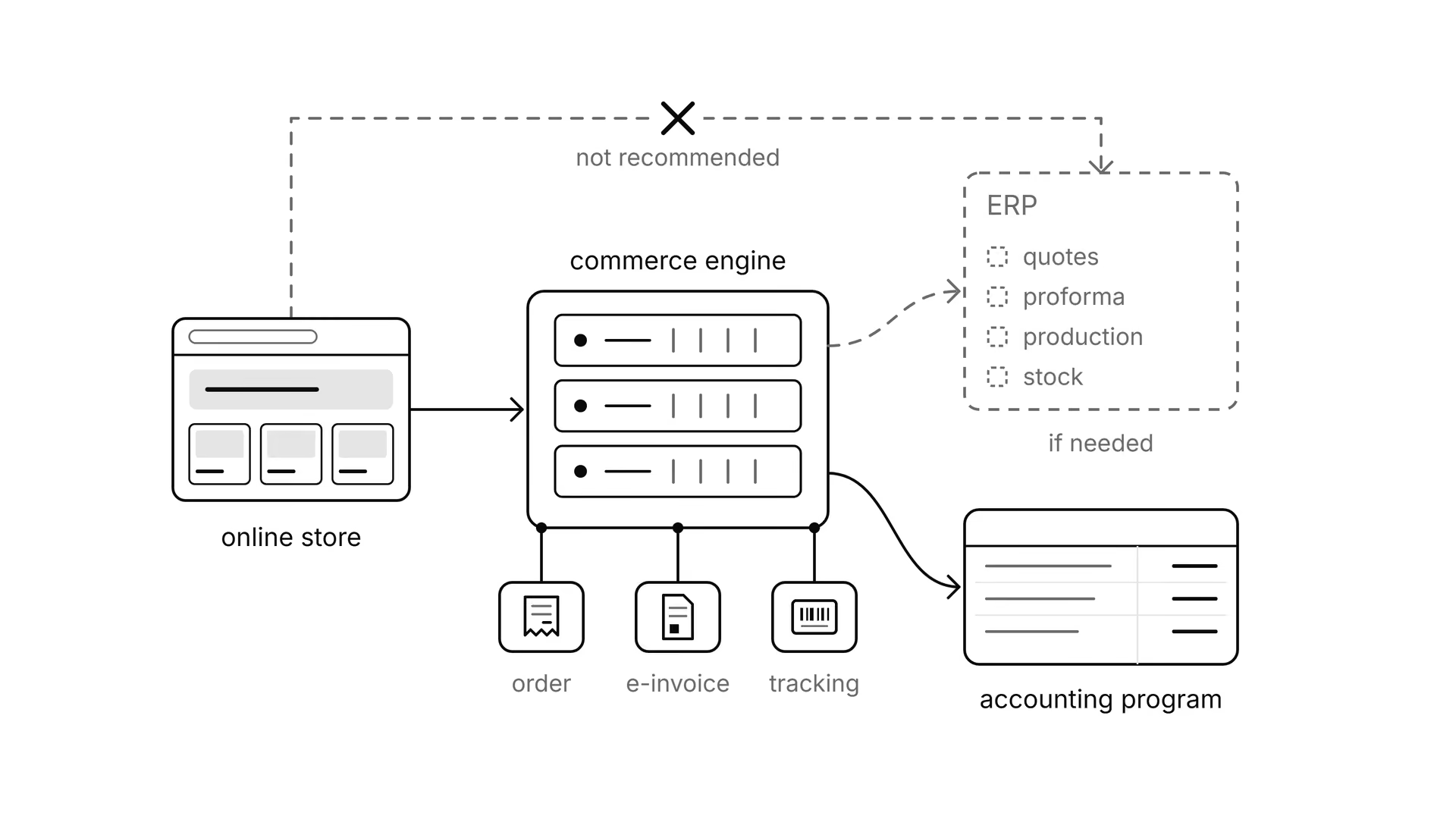
It is an architecture decision, and the answer depends on what the business wants to do. You do not have to connect an ecommerce site to an ERP at all. Orders landing on their own, invoices being issued automatically and tracking numbers reaching the customer can all be set up without one. An ERP starts to make sense when quotes, production and stock run inside it too. Even if you do connect one, we rarely recommend that the site talk to it directly. A layer in between, a commerce engine or a back end, usually gives you a sturdier setup.
Do you have to connect an ecommerce site to accounting?
No. Think of a WordPress site. An order comes in, the payment is taken, and someone issues the invoice by hand in the accounting program. For a small business that works perfectly well, as long as one person is looking after it. As the number of orders grows, that person starts spending their days issuing invoices and typing in tracking numbers.
If you want to automate the work, so that an order is recorded by itself, its invoice is issued, an e-archive invoice (e-arşiv, the invoice type for sales to consumers) or e-invoice goes to the customer, and the tracking number reaches them once the parcel ships, then your site has to talk to the accounting program. You do not need an ERP for that. A back end behind the site can take the order and pass it to the accounting program and the e-invoice integrator, and it can query the carrier's system and let the customer know. There is one more detail worth knowing about the e-irsaliye (e-dispatch note). According to the communiqué of the Revenue Administration (GİB), ecommerce sellers are not specifically required to use it. The requirement applies to certain sectors and to businesses registered for e-invoicing with gross sales above 10 million TL. Everyone else uses it if they wish.
When do you need an ERP?
An ERP earns its keep by running your business outside the site as well. If you give quotes from the ERP, prepare pro forma invoices there, plan production in it, and the finished products land on the product cards and in stock from there, then it makes sense to connect the site to the ERP so that it can show that stock. Otherwise the same stock is kept in two places, and one day they stop agreeing. We went into more detail on when you need an ERP in the ERP note.
But an ERP is a cost and a change of habits. It has to be set up, it runs on your own server or one rented in a data centre, and it needs maintenance and backups. More importantly, the team has to actually use it. An ERP that is installed and never used is pointless, and there is no reason to spend money on it. We prefer a simpler structure to a more complicated one: something sustainable, easy to understand and easy to manage. The aim is to simplify the business's operation and give it real benefit.
Why shouldn't the site connect to the ERP directly?
When a site connects to the ERP directly, the two share one fate. If the ERP slows down, the payment page slows down. If the ERP is down for maintenance, orders can be lost. If the ERP's version changes, the site's code has to change too. With a layer in between, the tie loosens. The site hands the order to the layer, the layer puts it in a queue, and it is written to the ERP when the ERP is ready. The checks that stop the same order being written twice, the shipping and invoice flows and the error logs also live in that layer. We explained why repeated notifications produce double records in the duplicate orders note.
This layer is often a commerce engine. The documentation of open-source Medusa sets up the ERP connection in exactly this way: a separate module that talks to the ERP, workflows that run when an order arrives, and scheduled jobs that sync products at set intervals. Still, this is not a rule. In a very simple setup, a middle layer can be needless complication too. Which is right depends on the kind of commercial operation the business wants to build.
Should you pick Logo, Mikro or an open-source ERP?
In Turkey, multi-company and long-established businesses mostly choose ERPs such as Logo, Mikro, Netsis or Canias. All of them offer a door for talking to outside systems. Logo's help system describes a REST service for Logo Objects. Mikro has an API that works with REST and JSON, but it requires an application form and a user agreement. Netsis is now a Logo product, and its own page lists NetOpenX and a REST API. Canias allows outside connections through its web service module. So a connection is possible, and it gets done. The hard part is that each ERP needs customisation according to its own rules, and that takes a developer's labour, which means a serious budget. We connect sites and the layer between them to these systems as ERP integration work. For two common cases, the steps and where most of the time goes are on our Logo ERP integration and Netsis integration pages.
With open-source ERPs, if you have your own developer, the process is somewhat cheaper and faster, and customisation is easier. Odoo's Community edition is licensed under LGPLv3 and ERPNext under GPLv3, and both offer a documented API. That is why we prefer open-source applications. But watch one detail here as well. According to Odoo's documentation, on Odoo's own cloud (Odoo Online) the API that outside systems connect to is open only on "Custom" plans. Before saying "we will connect to Odoo", check which plan you are on.
Is closed software as secure a bet as it looks?
We think no digital product's position is as secure as it used to be. Reverse engineering has been around for years. The project in which volunteers made Super Mario 64 rebuildable from source code is a well-known example. AI speeds this up. Academic work is being published on language models that turn compiled programs back into readable code. And in October 2026, PhotoCraft, an open-source look-alike of Photoshop, was talked about in the press as "a copy made with AI". The project's own page says plainly that it is an early version and does not replace Photoshop, but it points the way.
Our prediction is this: large, closed ERPs will in time get more open and cheaper look-alikes, and those companies will have to take a look at themselves. That is a prediction, not a fact. The conclusion we would draw for today is simple. Whichever ERP you choose, make sure you can export your data and that your site connects to it through a layer. If you change the ERP tomorrow, the site stays where it is and only one end of the layer changes.