Should you use a ready-made platform or custom software for your online store?
Ticimax, ikas and IdeaSoft get you selling fast but tie you to the platform. When custom software makes sense, and what to settle before you commission it.

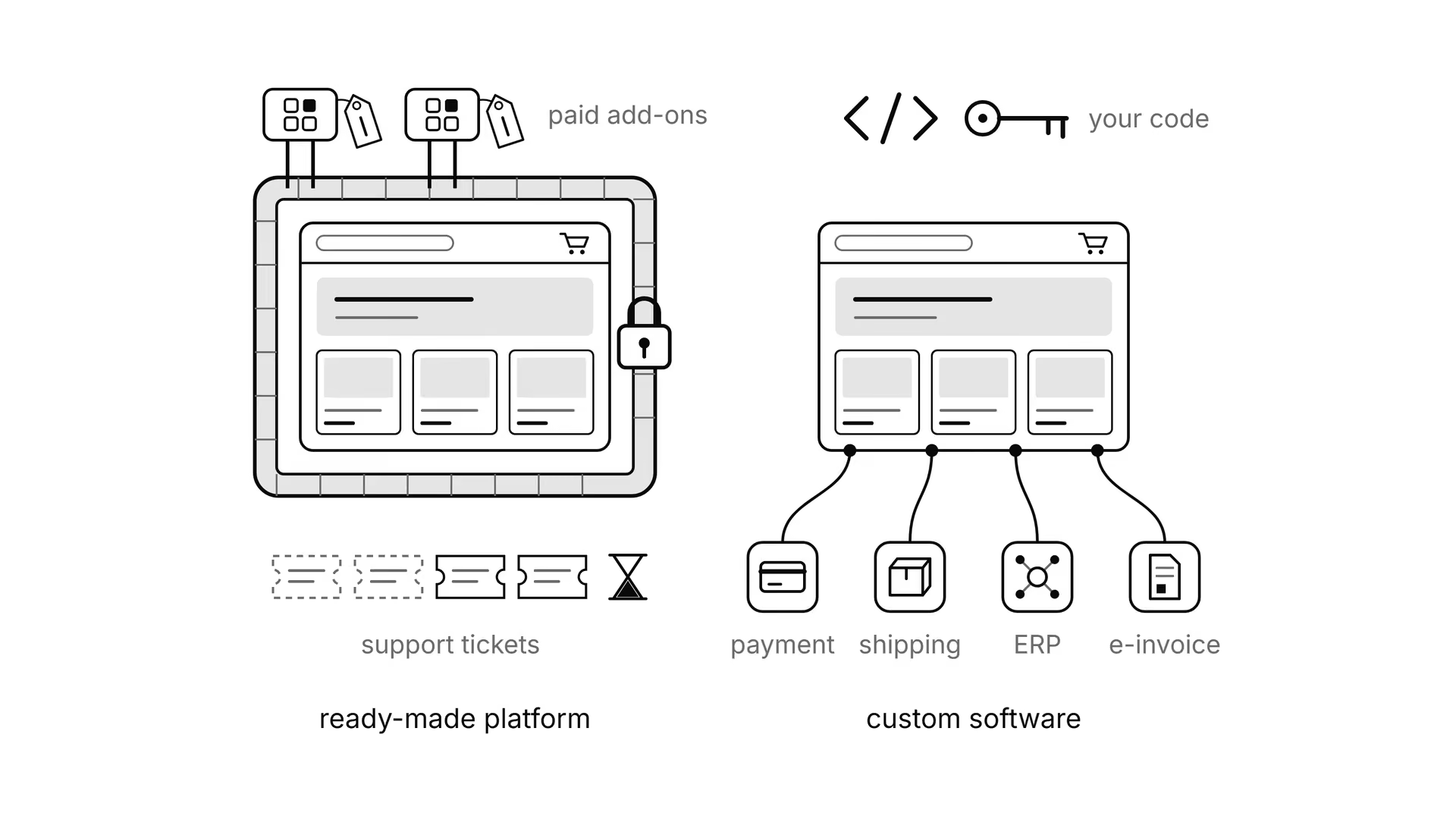
If you want to make your first sale quickly, a ready-made platform is often the right place to start. Turkish platforms such as Ticimax, ikas and IdeaSoft give you a store that opens in a short time, with payment, shipping integrations and an admin panel included. The price is dependence: the design changes only as far as the platform allows, a new feature waits on the platform's calendar or its app store, and new line items keep joining the bill as your needs grow. Custom software removes that dependence, and thanks to open-source foundations, payment providers' ready-made services and AI-assisted development, it is no longer the expensive, long job it used to be.
What does a ready-made platform give you?
The real value of a ready-made platform is that everything a store needs on day one comes ready. Payment providers are connected, agreements with carriers are in place, and products, orders and customers are managed from a panel. The platform looks after the server, the security updates and the backups. If you do not yet know whether your product will hold up in the market, this is the shortest way to put your money and time into the product itself. Starting on a ready-made platform is not a mistake; the mistake is starting without knowing where you will get stuck once the business grows.
Where does a ready-made platform reach its limit?
The limit usually shows up not in the first year but as the business grows. Platforms differ in how deeply they let you change the design. Ticimax, IdeaSoft and T-Soft say they allow HTML and CSS edits in the theme code. On Shopify you can edit theme code, but Shopify says that conflicting changes will be deleted when the theme is updated. On ikas, writing a theme is a developer's job. However deep you go, you stay inside the structure the platform has built: the flow of the checkout steps, what information a product can hold and which systems the site can talk to are the platform's decisions.
A new feature follows the same road. If the platform has it, you move up to a higher plan or buy a paid app from the app store; if it does not, you wait for the platform to add it. Ticimax and IdeaSoft show on their own pages that they can charge separately for add-on modules and apps. This is also what businesses that come to us from ready-made platforms describe most often: every new need means a separate invoice, sometimes an unexpected one, while tickets opened in the support panel take a long time and often do not give the result asked for.
Is it possible to leave a ready-made platform?
Yes, and your data is yours. Shopify, ikas and IdeaSoft give you products, orders and customers from the panel as Excel or CSV files, and on Ticimax and T-Soft the product list can be exported too. But exporting data is not the same as migrating. Customer passwords do not come with it; IdeaSoft's help page also says that member passwords are not exported, so your customers reset their passwords on the new site. The theme does not move; it is rebuilt. Most important are the addresses: if the old product URLs do not stay the same on the new site, each one has to be sent to its new address with a permanent redirect (301), or the visibility you have built up on Google is lost. We went through how the redirect list is prepared, step by step, in our note on SEO when you change platform. What comes with you and what does not when you leave ikas is covered separately in our note on migrating from ikas.
Why is custom software not as hard as it used to be?
A few years ago, writing an online store from scratch, connecting the payment system and running it safely was a big job. Today custom software does not start from zero. The core that manages the cart, the order, stock and returns is available as open source: Medusa is free under the MIT licence, Saleor under BSD, and WooCommerce, which runs on WordPress, under the GPL. We moved a bearing supplier's store, fifty years in the trade, off a hosted platform and rebuilt it on Medusa, connected to its ERP. Payment providers also offer their own ready-made services; we described how PayTR is connected to a site in our WooCommerce and PayTR note.
On top of that came AI-assisted development. In Stack Overflow's 2025 survey, 84% of the developers who took part use AI tools or plan to. The repetitive work that used to take a developer days has got shorter, which leaves more time for the work itself: your sales flow.
What should you settle up front if you commission custom software?
The freedom custom software gives you is only as large as what the contract says. You do not want to escape one platform's dependence only to become dependent on a software company, so talk about these before work starts: who owns the source code and will it be handed over to you, whose account the server and the domain name will sit in, who will do the updates and maintenance and for what fee, how requests after launch will be priced, and whether you can export your data whenever you want. We go through these questions before any ecommerce development job starts.