How much does an ecommerce website cost to build and run?
The plan price is only part of the bill. Which items set the yearly cost of an ecommerce site, on a ready-made platform and on custom software?


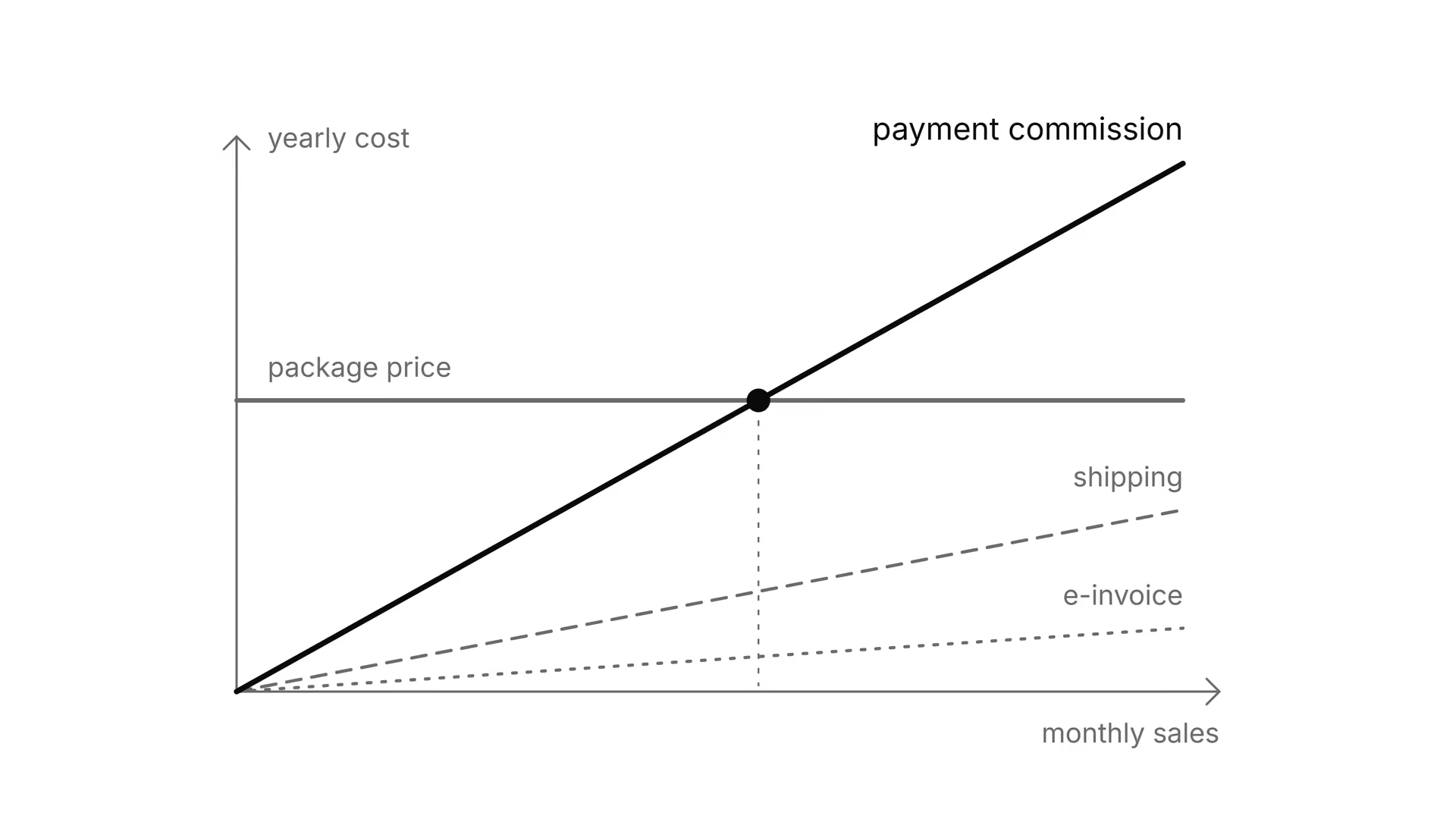
The cost of an ecommerce site is not one plan price but the sum of five items: the platform the site runs on, the commission your payment provider takes on every sale, shipping, e-invoicing, and the apps, themes or custom development added later. On ready-made platforms the entry plans start at free, and the top plans cost more than a hundred thousand lira a year. But as sales grow, it is not the plan that decides the bill; it is the items that grow with your sales. That is why you should compare a full year's total, not the monthly plan price.
How much do ready-made ecommerce plans cost?
Most ready-made platforms in Turkey publish their prices openly and sell their plans by the year. These were the starting prices we saw on the official pages on 23 October 2026:
| Platform | Starting price | Note |
|---|---|---|
| ikas | Start plan is free | Paid plans are billed yearly |
| Ticimax | Go plan 799 TL a month | VAT included; main plans from 46,000 TL a year |
| IdeaSoft | From 39,900 TL | VAT included |
| T-Soft | On quote | No figure on the page |
| Shopify | Basic $27 a month | $19 a month if paid yearly |
Prices change often with campaigns; we saw two different figures in two versions of the same price page on the same day. Before you decide, check the current price and whether VAT is included on the official page. When you compare plans, also look at what opens in which plan: if a feature you need sits in the next plan up, your real starting price is that plan's.
What do you pay besides the plan price?
The biggest item is often payment. On every card sale the payment provider takes a commission, and the rate varies by business. iyzico lists 4.29% + 0.25 TL per successful transaction for businesses selling more than 20,000 TL a month. PayTR lists a rate starting at 2.19%, but that rate is for the model where the money reaches your account seven days later; it sets the real rate by quote, depending on your sector, sales volume and instalments. Neither charges a setup or fixed monthly fee. The commission grows with your sales: on a million lira of sales a year, 4.29% alone comes to 42,900 TL, which is about what a yearly plan costs.
If you use Shopify there is one more item. Shopify's own payment system, Shopify Payments, is not available in Turkey, so a payment provider such as iyzico or PayTR is connected instead. In that case Shopify also charges a transaction fee on every sale: 2% on the Basic plan, 1% on Grow and 0.6% on Advanced. This fee comes on top of the payment provider's commission. Choosing Shopify's payment and shipping methods to match the companies you will work with in Turkey is covered on our Shopify store setup page.
On shipping, ready-made platforms make agreements with carriers and pass the discounted tariff on to their customers. ikas works with Aras, HepsiJET, Yurtiçi, DHL eCommerce and Kolay Gelsin; Ticimax highlights discounted shipping agreements on its Go plan. With custom software you make that agreement with the carrier yourself.
E-invoices and e-archive invoices, Turkey's electronic invoice formats, are also paid per document. At Paraşüt, for example, every e-invoice you send or receive counts as one credit (kontör); a package of 100 credits costs 400 TL + VAT and is valid for 12 months. We explained how to connect invoicing to your site in our note on e-invoice integration.
The last item is add-ons. Ready-made platforms have app stores, and some of the apps are paid: the stores of ikas and IdeaSoft have paid apps, and on Shopify you find one-off paid themes and monthly paid apps. Needs such as marketplace integration or collecting reviews are often met this way, and each one adds a separate line to the bill. The domain name and the SSL certificate are small items: .com.tr domain names have been available without submitting documents since 2022, and an SSL certificate is free with Let's Encrypt.
How much does a site built with custom software cost?
Custom software has no published plan price, because the scope sets the price. What widens the scope is less the number of products than the number of systems the site has to talk to: your ERP, your accounting software, e-invoicing, carriers, marketplaces. When we quote for ecommerce development, this list is the first thing we write down too. How custom the design will be and how many languages the site launches in also grow the job. Beside the one-time development fee, the server and maintenance are a monthly item; on the other hand, the platform's transaction fee and the app store bill disappear. Payment commission, shipping and e-invoicing are the same on both roads.
Which of the two roads suits you is covered separately in our note on ready-made platforms versus custom software.
How should you work out the cost?
Write a year down on a sheet of paper: the plan, or the development fee and the server cost; the paid apps you will use; the payment commission on the sales you expect (together with the transaction fee if you use Shopify); shipping per shipment; and e-invoice credits for the number of invoices you will issue. Do this total once for the first year and once for a year in which your sales double; the second calculation shows which item grows with your sales.