Can publishing too many pages sink my site on Google?
Is there a hidden Google formula that divides your links by your indexed pages? What the Panda patent actually says and how to grow a large site safely.

The number of pages alone does not sink a site. A post shared widely lately claims that Google divides your links and brand searches by the number of pages in its index, and that if the ratio is low the whole site disappears. We read the Panda patent it relies on and did not find such a division. But the post senses one thing correctly. Publishing many weak pages at once really can hurt a site. The reason is not a hidden formula but rules Google writes down openly.
What does the Panda patent actually say?
Patent US8682892B1, which the post relies on, was filed in 2012 and granted in 2014 to Navneet Panda and Vladimir Ofitserov, the engineers who gave the Panda update its name. The patent sorts pages into groups such as a domain or a folder and calculates a modification factor for each group. That factor is the ratio of the independent links pointing to the group to the reference queries aimed at it. A reference query is a search in which someone types your domain or your name. The factor is normalised against groups that receive a similar number of reference queries, and applied to the scores of results at the moment of the search.
In the post's formula, links and brand searches are added up and divided by the number of indexed pages. There is no such denominator in the patent's claims. The same team's second patent, US10055467B1, describes a similar method for adjusting group scores at search time. Besides, a patent shows that Google has protected a method. It does not show that Google uses that method as written today. According to Google Patents, the first patent also appears as expired for non-payment of fees.
What rule does Google state openly?
Google's spam policies include scaled content abuse. Generating many pages for the purpose of manipulating search rankings falls under it, and such sites may rank lower or not appear in results at all. The rule is the same whether a person or an AI writes the pages. What is looked at is whether the page gives the reader something. We saw this on our own news and blog site: getting the technical score to 100 brought no organic clicks, and the most clicks went to a free customer tracking program added to the blog.
The helpful content guide points the same way. It treats producing lots of content on many different topics, hoping some of it performs, as a sign of content written for search engines. The same guide also answers the fix the post proposes. It asks whether removing a lot of older content mainly to help your rankings will work, and says it will not. So mass noindexing pages to fix a ratio is, in Google's own words, not a remedy.
If traffic dropped to zero in a day, what might have happened?
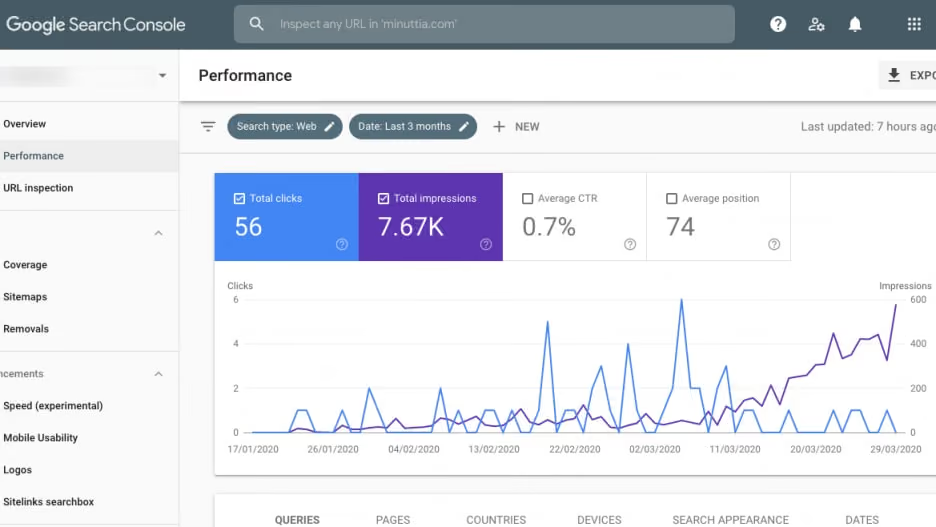
First check the dates in Search Console. According to Google's page on data delays, collected data is normally available within 2 to 3 days. That is why the last day or two of the chart often look incomplete and low. If you see a cliff at the end of the chart, wait a few days and look again. If the drop holds, check the Manual actions and Security issues sections in Search Console, then work out whether the drop is site-wide or limited to certain folders.
How do you grow a large site safely?
- Publish a page once it has something in it. Do not open an unwritten service page or a one-sentence tag page to the index. The empty pages on this site also stay out of the index until their text is written, and open on their own when it is. The aim is not to hit a ratio but not to show the reader an empty page.
- Make every page answer a real question. Writing a city or product name into a template and generating thousands of pages is exactly what the scaled content rule describes.
- Give the site a focus. A site that goes deep in one field tells both the reader and Google what it is more clearly than a site spread across every subject.
- Get people to search for you by name. Notes that get saved and revisited, and a site one customer recommends to another, grow searches for your name over time.
- Do not buy links, earn them. A trade site, an association or a customer citing you as a source is worth more than hundreds of weak links.
- Watch folder by folder as you grow. In Search Console, filter results by page path and follow each section's clicks separately. If one section drops, look for the problem there.
We run SEO on this site by these rules. The SEO services we provide for other sites rest on the same rules. We also have a note walking through why a site is not showing up: Why is my site not on Google?